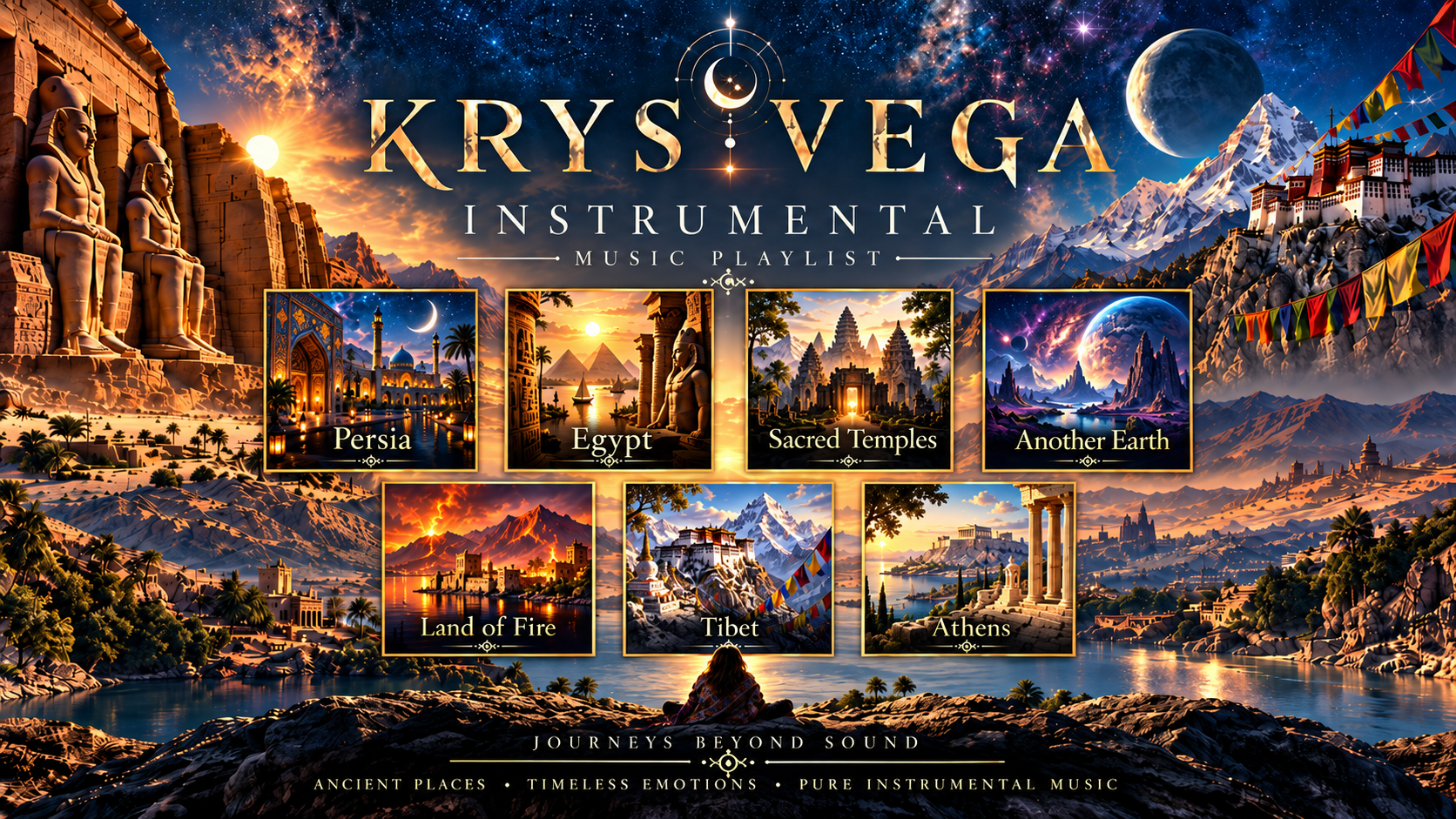
Krys Vega Instrumental Music Playlist — golden temples, Persian architecture, Tibetan mountains and cosmic landscapes. Journeys beyond sound.
Melody · Atmosphere · Emotion

Instrumental Music

Journey through ancient cultures and sacred places, beneath distant stars and into other dimensions. Music inspired by love, compassion and the mysteries that connect us across worlds. Listen to the collection on your favourite platform.

Explore the albums

Albums

All music collections
Krys Vega · Instrumental

Aether of Athena

The story behind the album

In Greek mythology, there is a story in which love, pride, death, divine jealousy, and the destiny of the stars become intertwined in an extraordinary way: the love story of Artemis and Orion.
Artemis, daughter of Zeus, was the goddess of the wilderness, the hunt, and chastity, fiercely protective of her freedom and never wishing to marry. Yet when she met Orion, a man of extraordinary strength and towering stature, a bond grew between them so profound that she could even imagine becoming his wife. This was all the more remarkable because the goddess who had never been willing to surrender her independence for anyone had finally found someone with whom she could envision a different future.

Her twin brother Apollo, however, opposed their relationship, and one day, while Orion was swimming far out at sea, he decided to exploit his sister's pride. Orion was so far from shore that only his head remained visible, appearing as a tiny dark speck among the waves. Apollo pointed toward the distant figure and challenged Artemis, questioning whether even she could strike such a small target. Proud of her exceptional skill as an archer, the goddess raised her bow, took aim, and released an arrow that unerringly found its mark.
What Artemis did not know was that the distant figure was Orion, and that her arrow had taken the life of the very person she loved.

When the waves eventually carried Orion's lifeless body back to shore, Artemis recognized her beloved and wept bitterly in the agony of that realization. Yet despite all her divine powers, she could not bring him back to life, and unwilling to let him disappear from the world forever, she lifted him into the heavens, among the stars.
Thus, he became one of the most recognizable constellations in the night sky.

Starlight takes time to reach us. When we gaze upon the constellation of Orion, we are actually seeing light that has traveled to us from the past.
The last light of a love, still on its way.

The tracks

01 Before the Fates

Artemis and Orion have no idea what awaits them. This is the joy of their time together, when love has no reason to be afraid and every possibility still lies ahead. Yet the title places this moment on the threshold between two worlds: before destiny unfolds, and before the Fates themselves, as though Orion were already standing before the goddesses who hold the thread of his life in their hands. He does not yet know what they already know.

02 Artemis and Orion’s Last Kiss

When Artemis finds Orion, she still believes she can save him. As a goddess, how could she be powerless against the death of someone she loves so deeply? The opening of the track is driven by this hope and a desperate determination to hold on to life. From its midpoint, however, the music begins to change: the pain of recognition and Artemis’s sobbing become increasingly present. Orion will not wake. Divine power reaches its limit, leaving a loving being alone with a loss she can neither understand nor accept.

03 Orion Celestis

In the midst of grief, a thought suddenly takes shape: Orion does not have to disappear forever. Artemis lifts him into the stars, where no one can ever take him from her again. The music opens up with this realization, and pain gives way to unrestrained exhilaration. It is almost an ode to joy: the joy of love finding a way when everything seemed lost. Jealousy may have taken a life, but it could not erase the bond between two beings. From now on, Orion shines in the night sky.

04 Elysian Rhythm

The closing track carries the story into another age. With its more modern sound, it seems to reach us from a future Greece, where the love of Artemis and Orion is still remembered. The world changes, but envy, jealousy, and the desire to destroy what we cannot possess remain part of human nature. And love remains too, surviving them all.
The album’s final message finds its fullest expression in this story living on into the future: love is the greatest power. Nothing can defeat it; it will always triumph over evil.

Krys Vega · Instrumental

Five Stories from the Land of Fire

The story behind the album

Azerbaijan is a place where landscape, history and spirituality seem to merge into one.
Near Baku, on the Absheron Peninsula, fire rising naturally from the earth has held a special significance for centuries. The Ateshgah Fire Temple preserves the memory of ancient fire worship, while on the nearby slopes of Yanar Dag, natural flames still burn today.
Further south, Gobustan is home to more than six thousand ancient rock carvings depicting hunting scenes, boats, caravans and ritual dances. This is also where the mysterious gaval dash can be found – a stone that produces an almost drum-like sound when struck.

Mugham, one of Azerbaijan’s most important musical traditions, is far more than melody alone. It is an improvisational, modal form of music whose history is also connected with Sufi communities and sacred performances.
It was from this world that Five Stories from the Land of Fire was born.

The five instrumental pieces are inspired by traditional Azerbaijani sound and feature some of its most distinctive instruments:
the tar, a long-necked plucked string instrument with a bright, resonant and remarkably expressive voice; its trills and ornamentation can sound both elegant and passionate
the kamancha, a bowed string instrument with a tradition stretching back more than a thousand years; its flexible, almost human, sometimes weeping voice often carries the deepest emotions
the balaban, whose soft, warm and veiled woodwind tone can evoke a distant memory or a human sigh
while delicate traditional percussion creates the slowly pulsing, organic foundation over which the melodies are free to unfold.

The instrumental traditions of the tar, kamancha and balaban, as well as mugham itself, are all included on UNESCO’s Intangible Cultural Heritage lists.
I wove the five pieces around five stories, each touching on a distinctive place or landscape of Azerbaijan.

The tracks

01 The Soul of Shirvan

The Soul of Shirvan is about a quieter, deeper kind of love: the bond that does not seek to possess, only to connect – with a person, a place, a memory, or something that feels like home.
Shirvan is one of the historic regions of the Eastern Caucasus, a land that for centuries had its own rulers and a strong cultural identity. The title therefore carries the idea of the soul of a landscape itself, as though the memory of the past and the emotions of the present could meet within the same silence.

02 Ancient Roads of Azerbaijan

Ancient Roads of Azerbaijan travels through ancient landscapes where old caravan routes were not only roads of trade, but paths followed by pilgrims and seekers as well.
The Diri Baba Mausoleum, standing along the historic Silk Road, has been a place of pilgrimage for travellers and merchants for centuries.
This piece is about the journey as an inner transformation – a road on which not only the landscape around us changes, but something within us changes too.

03 The Empty Courtyard of Sheki

The Empty Courtyard of Sheki is the image of an abandoned family courtyard. It is about the strange realization that objects often outlive us, continuing to hold the memory of those who once lived among them.
The music is a final journey back into an empty family home, to breathe in once more the familiar scent of its walls and old furniture.
Sheki is an ancient city in northern Azerbaijan, at the foothills of the Greater Caucasus. Once an important centre of historic trade routes and the silk trade, its old town and Khan’s Palace are now part of a UNESCO World Heritage Site.

04 Through the Gates of Baku

Through the Gates of Baku is the moment of arrival itself. Baku’s Old City stands in a place where traces of Zoroastrian fire culture, ancient sacred spaces and later Islamic traditions seem to overlap.
The Maiden Tower may once have been a fire temple or another kind of sacred structure.
Passing through the gates can therefore feel almost ritualistic – as though one were entering, through a modern city, a much older and invisible world.

05 When the Flame Grows Quiet

When the Flame Grows Quiet is the music of acceptance and letting go. It is about the moment when we stop fighting against pain and simply allow it to exist in silence.
The flame in the title also refers to Azerbaijan’s image as the Land of Fire. At Yanar Dag on the Absheron Peninsula, natural gas seeping through the earth feeds flames that burn directly from the ground.
In ancient Iranian and Zoroastrian traditions, such eternal fires were not seen merely as natural phenomena.
Fire represented purity, truth and divine order, and the region’s natural flames became sacred places and destinations for pilgrimage.
There were once several such burning rocks around Yanar Dag, revered by Zoroastrians as holy places, where the never-ending flame was believed to represent a connection between heaven and earth.

Five Stories from the Land of Fire is a journey through five stories born from the same extraordinary land: stories of love, remembrance, letting go, travelling and discovery – from the Land of Fire.

(And one small personal detail: one of my cats has fallen completely in love with this new album. Whenever he hears it, he comes running from wherever he happens to be, sits down in front of the speakers and listens with his eyes half closed, gently tapping the rhythm with his tail.
If you have a cat, try playing it for them too – perhaps they will love it just as much.)

Krys Vega · Instrumental

Sacred Temples of the Ancient World

The story behind the album

Five civilizations, one recurring melody, and twenty-five distinctive instruments shape the world of Sacred Temples of the Ancient World. The album unfolds as an expedition in musical archaeology, carrying the same musical idea through the sacred spaces of Sumer, Egypt, Persia, India, and Tibet, where each culture reshapes it through its own rhythms, melodic language, and tonal colors.

In each of the five compositions, the ancient and traditional instruments associated with that civilization perform the same melody, giving the recurring musical theme a new cultural voice at every stage of the journey.

The temple is the album’s central symbol: a place where architecture, astronomy, ritual, nature, and music converge within a single sacred space. The five compositions follow an aspiration expressed throughout human history—the desire to create a connection between earthly life and the infinite.

The tracks

01 Ziggurat of the Moon — Sumer

The Ziggurat of the Moon. The title refers to the Great Ziggurat of Ur, which stood at the heart of a temple complex dedicated to Nanna, the Sumerian god of the Moon. King Ur-Nammu began its construction in the twenty-first century BCE, and his son Shulgi completed it. The tiered structure rose above the city as a human-made sacred mountain, its terraces representing an ascent from the earth toward the divine realms.

Instruments 5
  • Bull-Headed Lyre: a plucked string instrument with a sound somewhere between a small harp and a lute. It can be recognized by its warm, full, short-decaying notes and the stately plucked phrases that articulate the melody.
  • Arched Harp: an early harp with a gracefully curved neck. Its soft, flowing tone appears in shimmering runs and delicate arpeggios.
  • Reed Flute: a wind instrument made from a hollow reed. Its breathy, slightly rough-edged voice reveals the player’s airflow at the beginning of each note.
  • Long-Necked Lute: a plucked instrument comparable to the modern saz or tanbur. Its dry, taut, gently nasal tone emerges through rapid repetitions and expressive pitch ornaments.
  • Frame Drum: an animal-skin membrane stretched across a shallow wooden frame, similar to a tambourine without jingles. Deep palm strokes and sharp finger taps create its ceremonial pulse.

02 Temple of the Eternal Sun — Ancient Egypt

The Temple of the Eternal Sun. In the Egyptian worldview, the Sun recreated the cosmos at every dawn, then began its journey through the underworld at sunset before rising triumphantly once again. The solar temples of the Fifth Dynasty, including the sanctuary built by Pharaoh Nyuserre at Abu Ghurab, directed attention toward the sunlight through open courtyards and monumental solar emblems. Their rituals sustained maat: truth, balance, justice, and the enduring order of the cosmos.

Instruments 5
  • Qanun – Arabic zither: a flat, trapezoidal instrument with many plucked strings, visually related to the zither and tonally reminiscent of both the harp and the hammered dulcimer. Its swift, pearl-like runs and glittering cascades of strings make it instantly recognizable.
  • Oud – Arabic lute: a short-necked, pear-shaped, fretless string instrument. Its deep, velvety, woody tone and subtle pitch slides bring warmth to the melody.
  • Ney – end-blown reed flute: a flute made from a long, hollow reed. Its veiled, airy, resonant voice resembles a distant human sigh.
  • Darbuka – Arabic goblet drum: a single-headed hand drum with a chalice-shaped body. It is easily recognized by the alternation between the deep central dum stroke and the sharp rim-based tek.
  • Riq – Arabic jingled frame drum: a small tambourine-like instrument fitted with metal cymbals. Bright metallic jingles and rapid rolls accompany its crisp drum strokes.

03 Garden of the Sacred Fire — Ancient Persia

The Garden of the Sacred Fire. The title unites two great symbols of Persian culture: the geometrically ordered garden and the sacred fire of Zoroastrianism. The chahar bagh, meaning “four gardens,” was divided into four sections by intersecting water channels, while water, vegetation, and shade transformed the arid landscape into an earthly paradise. The word paradise ultimately traces its ancestry to the ancient Iranian pairidaeza, meaning an enclosed garden. Sacred fire made visible the wisdom of Ahura Mazda and asha, the true and harmonious order of existence.

Instruments 5
  • Santur – Persian hammered dulcimer: a trapezoidal string instrument played with two lightweight wooden beaters. Its crystalline, sparkling clouds of sound and rapidly merging runs give it a distinctive radiance.
  • Setar – Persian long-necked lute: a small plucked instrument with a delicate voice. Its name means “three strings,” while its modern form usually has four. Quiet, dry, intimate tones, subtle tremolos, and sensitive ornaments define its character.
  • Tar – Persian lute: a long-necked instrument with a double-bowl, waisted resonator. Its bright, powerful, nasal tone rises above the ensemble through firm and articulate plucking.
  • Tanbur – long-necked ritual lute: a narrow-bodied plucked instrument whose recurring patterns create a meditative state. Its resonant fundamental tone, lingering vibrations, and hypnotic motifs make it easy to identify.
  • Tombak – Persian goblet drum: a chalice-shaped hand drum carved from a single piece of wood. Deep, rounded strokes are joined by rapid finger rolls, snaps, and intricate rhythms that often resemble speech.

04 Sanctuary of the Infinite — Ancient India

The Sanctuary of the Infinite. The spatial design of an Indian temple gradually guides the visitor from the diversity of the outer world toward a still inner center. Its innermost chamber is the garbhagriha, meaning “womb chamber,” where the image or symbol of the deity is placed. Rising above it, the shikhara evokes the cosmic mountain—Mount Kailash or Mount Meru—as the center of the universe. The title captures the moment when the boundaries of space, time, and individual consciousness dissolve into infinity.

Instruments 5
  • Sitar – Indian long-necked lute: a plucked instrument fitted with movable frets and sympathetic strings. Its metallic resonance, gentle buzzing timbre, extended pitch bends, and raga-shaped runs give it an unmistakable voice.
  • Sarangi – Indian bowed lute: a short-necked bowed instrument with a skin-covered resonator and numerous sympathetic strings. Its crying, voice-like tone, long gliding notes, and deeply emotional pitch bends are especially distinctive.
  • Bansuri – Indian bamboo flute: a simple side-blown flute made from bamboo. Its warm, airy, natural voice and gently floating melodic lines open a calm, meditative space.
  • Tabla – Indian drum pair: a high-pitched wooden drum played alongside a deeper drum made from metal or clay. The right hand creates clear, articulate rhythmic syllables, while pressure from the left hand produces fluid, pitch-bending bass tones.
  • Tanpura – Indian drone lute: a long-necked plucked instrument that maintains a continuous tonal foundation. Its evenly repeated, shimmering strings make the entire composition feel suspended upon one endless breath.

05 Monastery Above the Clouds — Tibet

The Monastery Above the Clouds. The title evokes Tibet’s high-altitude monasteries, where thin air, immense skies, and long natural reverberations become part of the ritual environment. The Potala Palace rises above Lhasa at an elevation of approximately 3,700 meters, while the Jokhang Temple, founded in the seventh century, brings together Indian, Nepalese, and Chinese artistic influences. Here the music reaches the highest point of its journey and gradually dissolves into the spacious silence of the mountains.

Instruments 5
  • Dungchen – Tibetan long horn: a telescopic brass instrument made from several sections, comparable to an immense Tibetan relative of the alphorn. Its extraordinarily deep, droning voice resembles a ship’s horn, a foghorn, or distant thunder.
  • Gyaling – Tibetan double-reed shawm: a wind instrument whose construction and sound production resemble the oboe and the traditional shawm. Its high, penetrating, nasal voice is shaped by rapid ornaments, strong vibrato, and continuous melodies sustained through circular breathing.
  • Drilbu – Tibetan ritual handbell: a small metal bell with an ornamented clapper. Its clear, high chime releases a long trail of metallic overtones that remains audible even above dense musical textures.
  • Damaru – Tibetan hourglass drum: a small double-headed drum whose cord-mounted beaters strike the membranes as the instrument is rotated. Its rapid, dry, trembling rattle appears in short rhythmic waves.
  • Silnyen – Tibetan ritual cymbals: a pair of flat metal cymbals with small central bosses. Bright clashes, accelerating rolls, and long metallic resonance mark the boundaries between musical sections.

The five compositions form a single spiritual arc:

Moon → Sun → Sacred Fire → Infinity → Sky and Silence

Krys Vega · Single-track album

Moonlight on the Silk Road

The story behind the music

Moonlight on the Silk Road is an ancient Persian-inspired, storytelling, atmospheric instrumental piece that evokes the world of old Persia and the Silk Road.
Its sound features characteristic Persian instruments such as the kamancheh, santur, ney, tanbur, barbat, and chang.

The Silk Road is only one passage in a story unfolding across many lifetimes. Perhaps the melody was born during a moonlit journey, its memory enduring from one life to the next—until, in this lifetime, it could finally become music. Moonlight on the Silk Road does not evoke the journey itself, but the unconditional love that arose between two souls as they travelled together.

A love that does not possess and does not depend on how long two people are allowed to remain beside one another. Once it has truly come into being, it can never be erased. When, in another lifetime, we once again behold someone we have loved before, we do not have to learn how to love them again: the feeling ignites instantly, because in truth, it never ceased to exist.

The song’s central motif symbolises this strange, elusive sensation. It is shaped to feel familiar—to awaken the impression that we have heard it somewhere before.

Inside the music

0:00–0:20

From 0:00 to 0:20, the motif appears only at the distant edge of the soundscape. Within the wide, airy space, upper harmonics trace tiny glimmers of light around it, while the melody itself has yet to reveal its full form. It is like the first glimpse of someone we could not possibly know—and yet recognise at once.

0:20–1:58

From 0:20 to 1:58, the motif gradually draws closer, unfolding again and again in subtle variations. The lower tones slowly give it substance, the midrange preserves the melody’s warmth, and the higher layers moving along the edges shimmer around it like moonlight. The music does not hurry. It allows familiarity to become certainty, and certainty to become whole love once more.

1:58–2:10

From 1:58 to 2:10, the music retreats deeply into itself. The layers grow thin and its presence almost disappears: this is death, the silence between lifetimes that seems to separate everything. Yet the melody is not destroyed. It merely loses its former shape.

2:10–2:30

From 2:10 to 2:30, the same motif is reborn in a new timbre, within a different space and carrying a transformed emotional weight. It is recognisable, yet no longer entirely as it was before. This is the composition’s central idea: musical reincarnation. What occurs is not a simple repetition, but a new embodiment of the same indestructible essence.

2:30–2:55

From 2:30 to 2:55, unconditional love ignites once more in its full intensity. The low frequencies suddenly acquire greater weight, the melodic layers grow denser, the stereo field opens wide, and the upper harmonics sparkle like light around the central motif. The low register gives the feeling its physical force, the melody at the centre preserves its identity, and the higher layers create the sensation that, in a single instant, recognition illuminates everything.

After 2:55

After 2:55, the music slowly recedes. The low frequencies release their hold on the melody, while the brighter, higher layers continue to linger in the surrounding space. This is not a final ending, but a crossing: love once again relinquishes its audible form, so that somewhere, in another time, it may be born anew.

Within this song, the melody dies and is reborn several times.
Death may bring one lifetime to an end, but it cannot erase a love that has truly come into being.

Instruments 6

The kamancheh is a bowed instrument with a flexible, almost human voice. Its long sustained notes, subtle slides, and microtonal bends give the melody an especially emotional character. In the piece, it provides the most deeply expressive, storytelling voice.

The santur brings a shimmering, crystalline, floating quality. With its many strings and delicate mallets, its sound seems to scatter through the space like light. It gives the music a more refined, dreamlike, and elegant Persian atmosphere.

The ney has a breathy, veiled, and solitary tone. Because the player’s breath is so present in its sound, it feels deeply human and spiritual. In the piece, it creates a quiet, meditative sense of a distant desert landscape.

The tanbur is a long-necked lute with a drier, deeper, and more hypnotic sound. Its gently pulsing, repetitive plucking lends a meditative and ceremonial character. In the music, it creates an ancient inner pulse that seems to guide the listener along the journey.

The barbat is a lute with a darker, warmer, and more velvety tone. Its soft, rounded sound adds depth and historical character to the arrangement, making the music feel richer, more intimate, and more timeless.

The chang, the ancient Persian harp, contributes a delicate, ethereal, almost celestial quality. It appears in the luminous, floating layers of the music, like the echo of a very distant memory.

Together, these instruments do far more than simply give the piece an “Eastern” color. The kamancheh brings emotion, the santur brings shimmer, the ney brings breath and spirituality, the tanbur provides the hypnotic ancient pulse, the barbat adds depth, and the chang contributes a timeless, ethereal light.

This is what gives Moonlight on the Silk Road the feeling of an old Persian journey coming back to life through music.

Krys Vega · Instrumental

Nermin’s Dream

An Egyptian Musical Journey

Some journeys never truly end. They live on in our hearts, in the memories we treasure, and in the friendships that make life beautiful.
Nermin’s Dream is an instrumental album inspired by the unforgettable moments I shared with my dear Egyptian friend, Nermin.

From the ancient wonders of Luxor to the legendary Library of Alexandria, from sipping hibiscus tea in a Cairo club to watching dolphins dance across the sea, every melody carries a little piece of our journey.
We swam among colorful coral reefs, watched the sun rise over the peaceful sea, shared our dreams, and imagined all the beautiful things the future might bring.

These memories will always hold a special place in my heart. But more than the places we visited, this music celebrates something even more precious: the joy of a friendship that crosses borders and connects two hearts.

I created this album as a birthday gift for Nermin, with one very special wish:
May every dream you carry in your heart find its way into reality.
Happy Birthday, my dear friend. May your life be as beautiful as the memories we have created together.
With love,
Kriszti

The tracks

  1. Temple of Roses
  2. Magic of Hathor
  3. Breeze of the Nile
  4. Sunset Over Luxor
  5. Hibiscus at the Dolphin Club
  6. Whispers on the Steps of Isis
  7. Cairo After Midnight
Krys Vega · Meditation · Compassion

The Way of Compassion

A Spiritual Journey Along the Sacred Path of Love

There are teachings that do more than awaken thoughts within us. They touch the deepest places of our souls, reminding us of something we may have always known, yet slowly forgotten amid the noise of everyday life: that love is one of life's most sacred gifts, and that we are all connected by invisible threads.
The Way of Compassion was inspired by the teachings of His Holiness the 14th Dalai Lama on love, meditation, and compassion.

What touched me most deeply was the importance he places on meditation: the realization that meditation is not merely a search for inner peace, but also a path toward opening the heart. When we quiet our minds and turn our attention toward all living beings with love, we gradually begin to recognize that we do not exist as separate, isolated souls. The joy, suffering, and longing for happiness of others are just as real and precious as our own.
One of the most beautiful messages I have found in His Holiness's teachings is that genuine compassion can be consciously cultivated. And the love awakened through meditation truly comes alive when we step beyond the silence and carry that love into our everyday lives.

Compassion is more than a feeling. It is the soul's recognition that the suffering of another human being can never be entirely separate from our own.
From this understanding, a musical journey of six compositions was born.

Five editions explore the mystical landscapes of Tibet, its ancient sacred places, and its spiritual heritage. They share a common musical inspiration, while each leads the listener into a different landscape of the soul. A sixth, purely instrumental piece, Deep Temple Yoga, closes the journey.

The music

01 Moonlight Edition – The Silence of Moonlight

The journey begins beneath the silver glow of the moon. The world grows quiet, thoughts slowly come to rest, and the gates of inner peace begin to open. Here, moonlight symbolizes contemplation, acceptance, and the purity of the soul. A moment when we no longer search for anything, but simply allow ourselves to be embraced by silence.

02 Sky of Tibet Edition – The Infinite Sky of Tibet

Beneath the vast Tibetan sky, the soul seems to free itself from earthly limitations. The endless horizon, the stars, and the cosmic expanse remind us that we belong to an immense and mysterious universe. This musical world speaks of freedom, spiritual ascension, and the invisible unity that connects all existence.

03 Yarlung Edition – The Sacred Flow of Life

The Yarlung Tsangpo, Tibet's mighty ancient river, becomes a symbol of constant transformation and the eternal flow of life. Just as the water moves endlessly along its course, life carries us through experiences, encounters, and moments of awakening. This composition is a peaceful journey upon the river of existence, where we learn to trust the path before us and release everything we no longer need to carry.

04 Kailash Edition – The Calling of the Sacred Mountain

Mount Kailash, rising north of the Himalayas, is one of the world's most extraordinary spiritual pilgrimage sites, revered as sacred in Buddhism, Hinduism, Jainism, and the ancient Bön tradition.
The mountain symbolizes the meeting of heaven and earth, purification, and spiritual ascension. The music invites us on an imaginary pilgrimage, where every step brings us closer to our true selves. The summit becomes a symbol of the deepest truth within our own souls.

05 Amrita Edition – The Nectar of Immortality

In ancient Indian spiritual traditions, Amrita is the divine nectar of immortality. To me, it symbolizes the renewal of the soul, the timelessness of pure love, and the inner light that even life's greatest hardships cannot extinguish.
This composition is a celebration of spiritual rebirth and unconditional love. A musical expression of the realization that what is truly precious within us transcends the fleeting moments of earthly existence.

06 Deep Temple Yoga – The Inner Sanctuary

The album's final composition was created especially for meditation, yoga, and profound inner stillness.
This purely instrumental piece leads us into the peace of an imaginary ancient sanctuary, where the outside world slowly fades away, breathing deepens, and body, mind, and soul return to harmony.
Here, there are no words, no expectations, and nowhere we need to hurry. Only the present moment remains, and the quiet, loving awareness through which we may rediscover both ourselves and the world around us.

A prayer for humanity

Yet The Way of Compassion is more than a musical album. It is a dream I carry within my heart.
A dream that one day, we will all come to recognize that we are children of one great human family.
Although we are born in different countries, speak different languages, pray to different gods, and follow different paths in search of happiness, deep within our souls we all long for the same things: love, peace, safety, and the comfort of being truly understood.
We did not come into this world as strangers, but as fellow travelers, blessed with the opportunity to walk together along this wondrous, sometimes painful, yet infinitely precious journey called life.

I believe that every loving thought, every sincere embrace, every act of forgiveness, and every selfless gesture of kindness is a small ray of light that makes our shared world a more beautiful place.
And perhaps this is where one of life's deepest and most sacred mysteries lies: that divine love does not dwell only among distant stars, upon the holy summits of mountains, or within the silence of temples. It also lives within every human heart capable of reaching toward another soul with love.

May we learn to see one another as members of one great family. May we accompany each other on this earthly journey with greater tenderness, patience, and mercy. May we never forget to lift those who have fallen, comfort those who suffer, and share our joy with those who are longing for even the smallest glimmer of light.
For perhaps, in the end, what truly matters is not how far we have traveled in life, but how much love we have left behind.

This is my dream. This is my prayer for humanity.
And this is why The Way of Compassion was born.
With love,
Krys Vega

Lyrics

Deep within the heart
Since the dawn of time
Peace has always lived
Quieter than any thought

Peace is not waiting
Outside of you

The Infinite asks
Only this of you
Be who
You have always been

The quiet flame of compassion
Kindles dawn
In every wounded heart

Make peace within your soul
And the world grows still

Love does not search for a way
Love itself is the way

May there be within you
Stillness
Trust
And pure light

From silence
Strength is born
From love
Hope is born

May there be within you
The courage
To live from the heart

Whoever finds peace within
Awakens peace
In other hearts

Nothing can divide us anymore
When we look upon one another
With love

The wisdom of the heart
Teaches us to see

A new world is born
Within every soul at peace

Every breath we draw
Is a new beginning

The breath
Guides us home

When the mind falls silent
The Infinite unfolds

Compassion speaks
Every fear dissolves

The mind opens wide
And every boundary falls away
We were never separate

May there be within you
Stillness
Trust
And pure light

From silence
Strength is born
From love
Hope is born

May there be within you
The courage
To live from the heart

Make peace within your soul
And the world grows still

Love does not search for a way
Love itself is the way

May your path be blessed

Krys Vega · Instrumental

Sunrise Ritual Beneath Vega

A Dawn Ceremony Beneath the Star of Vega

Some 25 light-years from Earth, in the constellation of Lyra, shines Vega, one of the brightest stars in the night sky, glowing with a brilliant blue-white light. For thousands of years, it has drawn humanity's gaze toward infinity, and long ago, it even served as the North Star. Surrounding it is a vast ring of cosmic dust, perhaps holding secrets of distant worlds yet to be born.
But Vega holds a special place not only in astronomy. Modern spiritual legends and stories of extraterrestrial civilizations sometimes trace the origins of advanced intelligences from other worlds to the constellation of Lyra. In Carl Sagan's famous novel Contact, the first message to establish a connection between humanity and a distant civilization also arrives from the region of Vega.
These stories evoke the image of a mysterious universe filled with infinite possibilities. A cosmos where perhaps the reality we know is not the only plane of existence, and where other consciousnesses, other dimensions, and forms of life still unknown to us may await discovery among the stars.

I love to imagine that love is not merely a gift of human existence, but a universal, invisible force capable of connecting souls beyond the boundaries of space and time. That somewhere in the infinite universe, perhaps other beings gaze upon the stars with the same wonder that we do, longing for the same peaceful, loving connection.
Perhaps the greatest mystery of the universe is not whether life exists among distant stars, but how extraordinary it would be to one day recognize the same divine light within one another.

There is a magical moment where night meets dawn, when the world is still dreaming, yet the light is already making its way toward us. When the stars slowly begin to fade, and something new prepares to be born within the infinite silence.
Sunrise Ritual Beneath Vega is a mystical celestial journey that begins in the deepest darkness and gradually unfolds into the radiance of the rising sun.
Beneath the star of Vega, a solitary kamancheh begins to sing. Its melody sounds as though an ancient soul were telling the story of all the beauty and sorrow it has encountered throughout its long wandering. The santur responds with crystalline clarity, while the breathlike melodies of the ney flute and the delicate expressions of the setar join this extraordinary, wordless conversation.
The distant vibrations of Tibetan singing bowls transform the starry sky into a sacred sanctuary, while deep bass and the pulsating rhythms of ancient Eastern drums slowly awaken the heartbeat of life.
As dawn approaches, the music rises ever higher. Pain gradually transforms into beauty, sorrow into hope, and darkness into radiant light. The ancient melodies of Eastern instruments and hypnotic electronic rhythms merge into a single uplifting, ecstatic celebration.

And when the sun finally rises, it feels as though the universe itself is opening its heart.
This moment is the rebirth of the soul. The realization that even the darkest night cannot last forever, and that every ending carries within it the promise of a new beginning.
The music slowly returns to silence. The final crystalline notes of the santur scatter across infinite space, the kamancheh sings one last phrase, and its melody gently dissolves into cosmic peace.
Sunrise Ritual Beneath Vega is a wordless prayer to the light. A tribute to the eternal cycle of life, and a reminder that no matter how deep the darkness we journey through, somewhere, the light of dawn is always being born.
For the light does not rise only upon the horizon. Sometimes, it is reborn within our own souls.
Krys Vega

Krys Vega · Instrumental

Trip to Another Earth

A Journey to Another Earth

What if another Earth existed? A world where we had made different choices. Where we had learned to live in peace with one another, to care for life, and to recognize that the happiness of others is just as precious as our own.
My instrumental piece Trip to Another Earth was inspired by the film Another Earth. What touched me most deeply was the question of whether we could give up our own chance at a new beginning so that someone else might have another opportunity. To me, compassion becomes truly tangible in that selfless choice.

When I dreamed of this music, I imagined a journey through space. You take your seat aboard a spaceship, knowing that something extraordinary awaits you. The familiar world slowly disappears into the distance. Ahead lie the stars; within you are the joy of discovery and the excitement of a new beginning.
The music accompanies this journey: gentle organic rhythms, floating electronic melodies, and a gradually unfolding hypnotic pulse carry you into the unknown.

On my other Earth, our progress is reflected in our relationships too. We have understood that all life is interconnected and learned to treat one another with greater care, tenderness, and responsibility. We have carried with us everything that is beautiful within us and let go of the things through which we repeatedly caused pain.
This imaginary journey leads toward that world — toward a more loving possibility for ourselves and our shared lives.

Perhaps love, compassion, and gratitude can lift us there. And perhaps we do not need to leave Earth to reach it. With every act of forgiveness, every selfless gesture of help, and every decision that considers the well-being of others, we are already shaping the world we wish to live in.
Perhaps the journey to another Earth begins within our own hearts.
Shall we begin our journey?
With love,
Krys Vega